At a glance
| Detail | |
|---|---|
| What it is | Greco-Roman city crowning the Mesa Vouno ridge above Perissa |
| From Perissa | ≈4 km · ~15 min drive, or a 45–60 min hike up (~350 m gain) |
| Founded | By Dorian settlers from Sparta (traditionally 9th c BCE) |
| Entry | |
| Hours | Main season daily except Wed, ~08:30–15:30 (reduced in winter) |
| Best for | Ancient history, ridge views, hiking |
| Time needed | Half-day |
The clifftop city above Perissa
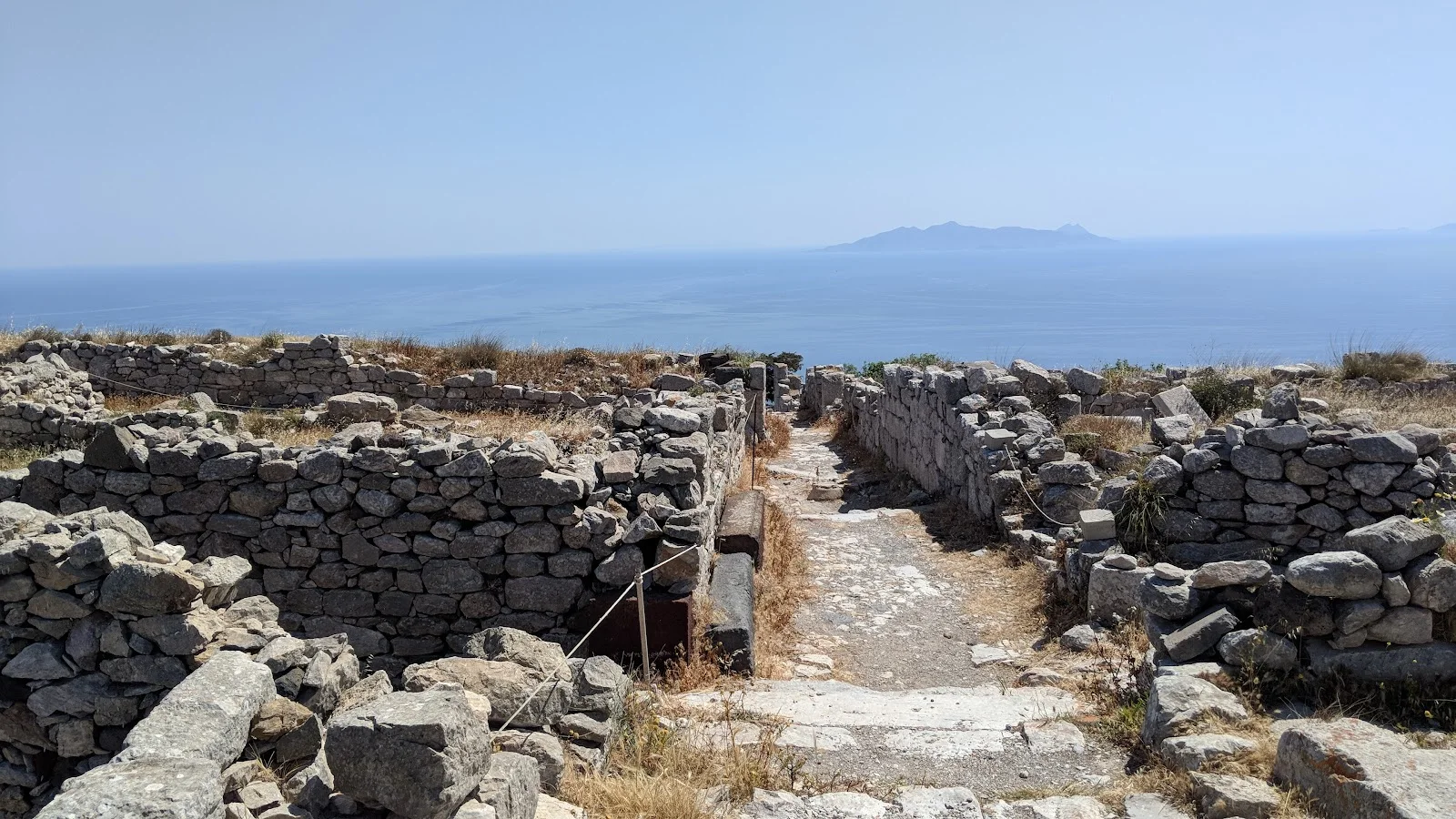
Ancient Thera is the Greco-Roman city that crowns the ridge of Mesa Vouno, directly above Perissa — a spectacular archaeological site strung along a high spine of rock, with the black-sand beach on one side and Kamari on the other. It is the standout historical sight of this side of Santorini.
Founded by Dorian settlers from Sparta — traditionally in the 9th century BCE, under a leader named Theras, who gave both the city and the whole island their name — and built up through the Hellenistic and Roman periods, the city occupied the naturally defensible spine of Mesa Vouno for over a thousand years. Excavations have revealed houses, an agora, temples, cisterns and rock-cut inscriptions — among them some of the earliest alphabetic Greek writing to survive, 7th- and 6th-century-BCE names and prayers carved into the rock around the sanctuary of Apollo Karneios and the Terrace of the Festivals.
What to see
- The long processional street running along the ridge, lined with building foundations.
- House and temple foundations, the agora, cisterns and rock carvings.
- The Terrace of the Festivals — the site's great viewpoint, where archaic dancers left some of Greece's oldest carved inscriptions.
- The huge views — straight down to Perissa on one side and Kamari on the other, with the Aegean beyond.
Give yourself time to walk the full spine of the site; the ruins spread out along the rock rather than clustering in one spot.
How to get there
Ancient Thera sits on the ridge of Mesa Vouno, about 370 m above the sea, and there are two ways up:
- By road — a steep road climbs from the Sellada saddle above Kamari; the easiest option, and you can drive or taxi up.
- On foot — a demanding path climbs from Perissa or Kamari, going straight up from the black sand via the Mesa Vouno ridge hike to the Sellada saddle. The Perissa side is steep and rocky but short, gaining around 350 m in roughly 45 minutes to an hour; it is exposed with little shade.
Either way, wear sturdy shoes and bring water and sun protection. Go early in the morning for cooler air and clear light. Entry is around €10, or covered by the ~€15 three-day multi-site ticket that also includes Akrotiri — worth it if you are doing more of the island's archaeology. See our full Ancient Thera guide to plan the visit.