
The Name Perissa
A black-sand village below an ancient city, the story behind the name.
What Perissa Means: The Quick Answer
Perissa is most often said to come from the Greek word for "surplus" or "what is left over", a name linked by local tradition to the settlement that remained below the abandoned ancient city on the mountain above.
The usual explanation traces it to perísseia (περίσσεια) / perissós (περισσός), "surplus, abundant, that which remains." It is a folk etymology rather than a documented fact, so treat it as tradition.
In Greek the village is Περίσσα, on the southeast coast of Santorini (Thira), directly below Ancient Thera on the Mesa Vouno rock.
A Name Said to Mean "What Is Left Over"
Unlike many Greek places named for a saint or a founder, Perissa carries a name that most accounts read as a plain description. The common explanation ties it to the Greek perísseia / perissós, "surplus," "abundant," or "that which remains", for the village that grew on the plain below, after the old city on the heights was left behind.
This is local tradition rather than a documented derivation, and you will hear more than one version told on the island. What is not in doubt is the setting: a long black volcanic-sand beach at the foot of Mesa Vouno, the great rock that separates Perissa from Kamari on the far side.
The Ancient City on the Mountain
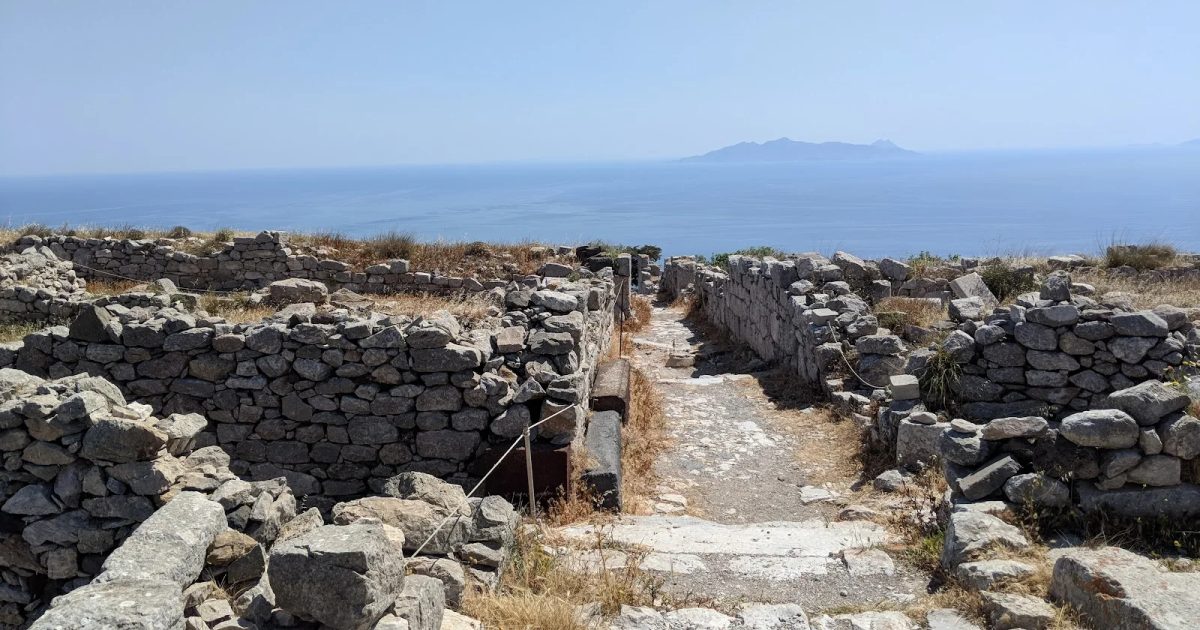
High on the ridge of Mesa Vouno, directly above the beach, lie the ruins of Ancient Thera (Archaia Thira), the old hilltop city of the island, founded in antiquity and lived in through the Hellenistic and Roman eras before it was gradually abandoned. Its terraces, agora, and temples still crown the rock, reached by a switchback road or a footpath up from Perissa.
Down at sea level, the village's own history runs deep too: the large blue-domed church of Timios Stavros (Holy Cross) stands over the remains of an early-Christian basilica, hinting at how long people have gathered on this stretch of coast. It is easy to see how a settlement clustered below such a place could take a name meaning simply what remained.
For the wider story of the village and its beach, see our About Perissa guide.
Why We're Called Perissa.net
We took the village's own name, Perissa, because that is exactly what this guide is about: one long black-sand beach on Santorini, the tavernas and beach bars along it, and the ancient city on the rock above. Simple, local, and rooted in the place itself.
Explore Perissa
Discover the beach, the tavernas, and the ancient ruins that give Perissa its character.