At a glance
| Detail | |
|---|---|
| What it is | Bronze-Age town buried by the ~1600 BC eruption — "Minoan Pompeii", under cover |
| From Perissa | ≈14 km · ~25 min by car (bus via Fira: ~€2.70 + change) |
| Entry | |
| Hours | ~08:00–20:00 summer; shorter (08:30–15:30) Mon & Thu |
| The frescoes | Mostly moved to the Museum of Prehistoric Thera, Fira — plan two stops |
| Best for | Ancient history, frescoes, a shaded midday visit |
| Time needed | ~45 min–1.5 h; a half-day southern loop |
Santorini's 'Minoan Pompeii'
Akrotiri is a Bronze-Age town on the island's southern tip — the best-preserved prehistoric settlement in the Aegean, and once one of its most important towns and ports — that was buried under metres of volcanic ash when the Thera volcano erupted around 1600 BC, and preserved almost intact beneath it. Unlike the Roman Pompeii, no human remains have been found here, suggesting the residents fled before the eruption. Today the whole excavation sits under a vast modern roof, with raised walkways carrying you over multi-storey houses, paved streets and drainage systems advanced for their age.
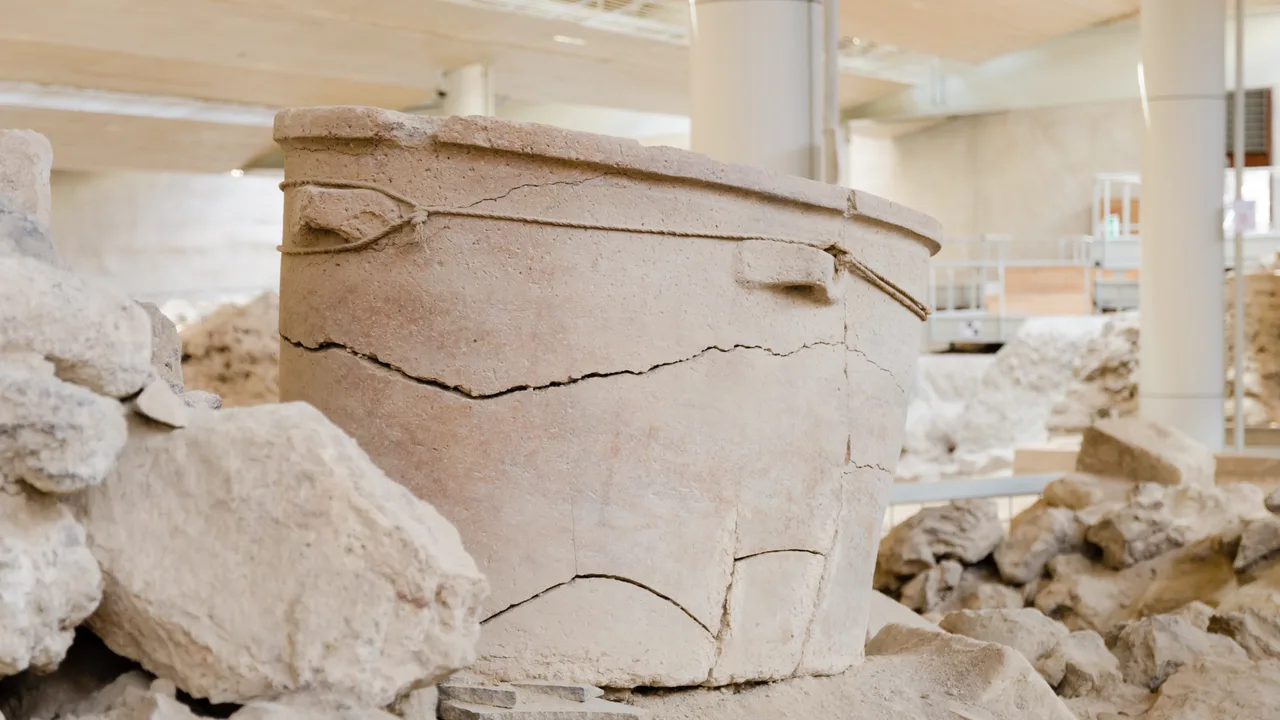
Because the ash sealed everything so quickly, you walk through a real Bronze-Age town rather than a scatter of foundations: buildings still stand two and three storeys high, with window and door openings, staircases and storage jars (pithoi) left where they stood. The covered roof keeps the site shaded, which makes it a good midday option when the beaches are baking. What you won't see in place are the famous frescoes — the spring lilies, blue monkeys, boxing boys and ship fresco — most of which were lifted for conservation and are displayed in the Museum of Prehistoric Thera in Fira. A complete Akrotiri visit therefore really means two stops: the site here in the south, and the museum up in the caldera capital.
Plan on roughly 45 minutes to an hour and a half at the site. An audio guide or short guided tour is worth it — without context the ruins are impressive but hard to read.
2026 fees and hours
Santorini's site fees were revised in late 2025, so older guidebooks quote lower numbers. As of 2026 the standard Akrotiri ticket is around €20 (roughly €10 reduced, with free entry for under-18s and EU under-25s — bring ID). Counter-intuitively, the multi-site 3-day combined ticket is around €15 — cheaper than the single Akrotiri entry — and also covers Ancient Thera and the Museum of Prehistoric Thera, so ask for it at the desk if you plan to see more of the island's archaeology. Hours run roughly daily 08:00–20:00 in high summer, with shorter hours (08:30–15:30) on Mondays and Thursdays; the site has occasionally closed for structural inspections, so check before a special trip.
Reaching Akrotiri from Perissa
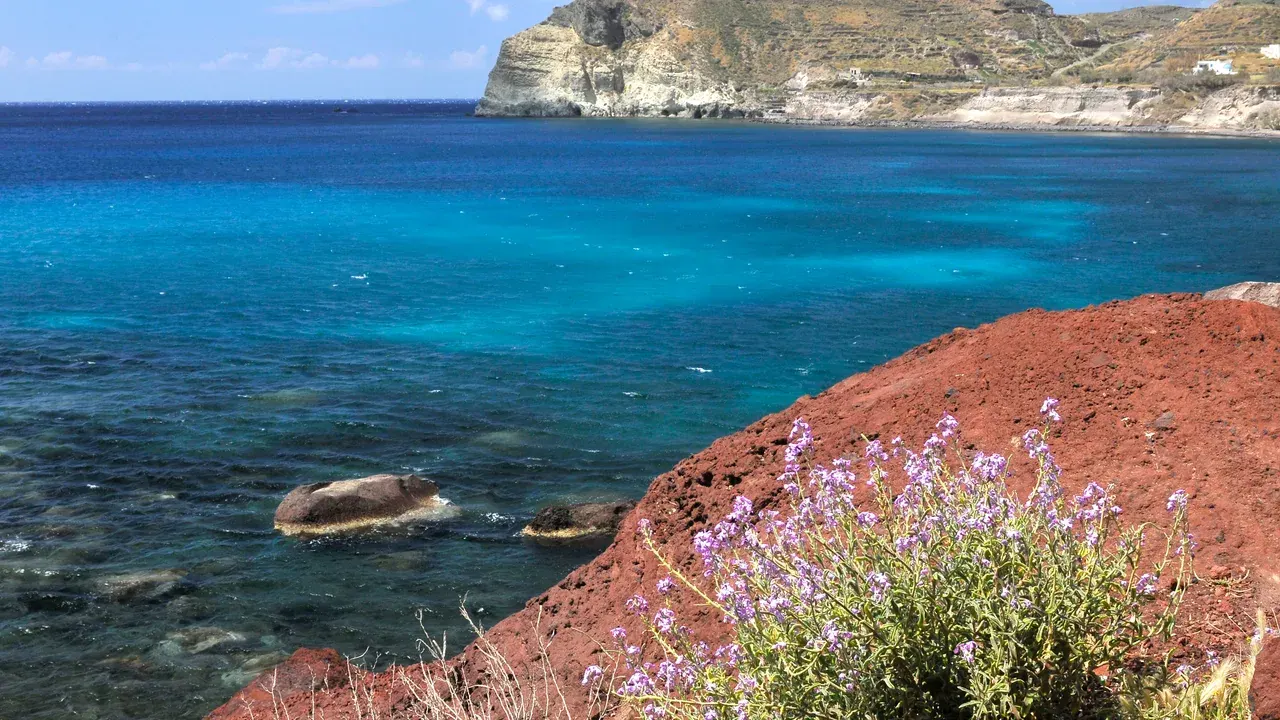
Akrotiri village sits on the southwestern tip of the island, with no coast road linking it directly to Perissa, so every route runs via the interior. By car or taxi it is the simplest: roughly a 20–30 minute drive, passing close to the Red Beach, White Beach and the old lighthouse — easy to string into one southern loop. By bus, take the KTEL from Perissa to Fira (~25 min, ~€2.70), then change onto the Fira–Akrotiri service, which is slower.
Treat Akrotiri as the anchor of a half-day southern loop: the covered excavation first thing, then the short drive to the Red Beach for a look, and the lighthouse at the very tip. See our Akrotiri Santorini guide for the full detail.