Akrotiri is Santorini's "Minoan Pompeii". A Bronze-Age town on the island's southern tip that was buried under metres of volcanic ash when the Thera volcano erupted around 1600 BC, and preserved almost intact beneath it. Unlike the Roman Pompeii, no human remains have been found here, suggesting the residents fled before the eruption. Today the whole excavation sits under a vast modern roof, with raised walkways carrying you over multi-storey houses, paved streets and drainage systems that were advanced for their age. If you're basing yourself in Perissa, Akrotiri is one of the easiest and most rewarding day trips on the island, and it pairs neatly with the nearby Red and White beaches. Here's what to see, what it costs in 2026, and how to get there.
TL;DR: Akrotiri from Perissa at a glance
| Question | Short answer |
|---|---|
| What it is | A Bronze-Age town buried by the ~1600 BC Theran eruption, excavated under a covered roof |
| Why go | Intact streets and multi-storey houses, advanced for their time; sister site to Ancient Thera |
| Entry fee (2026) | ~€20 standard / ~€10 reduced; a ~€15 three-day multi-site package also covers Ancient Thera and museums |
| Where the frescoes are | Mostly in the Museum of Prehistoric Thera in Fira, not on site |
| Hours | Roughly daily 08:00–20:00 in summer, shorter (08:30–15:30) some weekdays, confirm before you go |
| From Perissa | Car/taxi ~20–30 min, or KTEL bus via Fira; near the Red and White beaches |
What you actually see at Akrotiri
The excavation is genuinely unusual: because the ash sealed everything so quickly, you're walking through a real Bronze-Age town rather than a scatter of foundations. Raised walkways thread between buildings that still stand two and three storeys high, with window and door openings, staircases, storage jars (pithoi) left where they stood, and a street drainage system beneath your feet. The covered roof keeps the whole site shaded and out of the sun, which makes it a good midday option when the beaches are baking. The modern excavation was begun in 1967 by the Greek archaeologist Spyridon Marinatos, who died at the site in an accident in 1974 and is buried just beyond the ruins. His grave is still there.
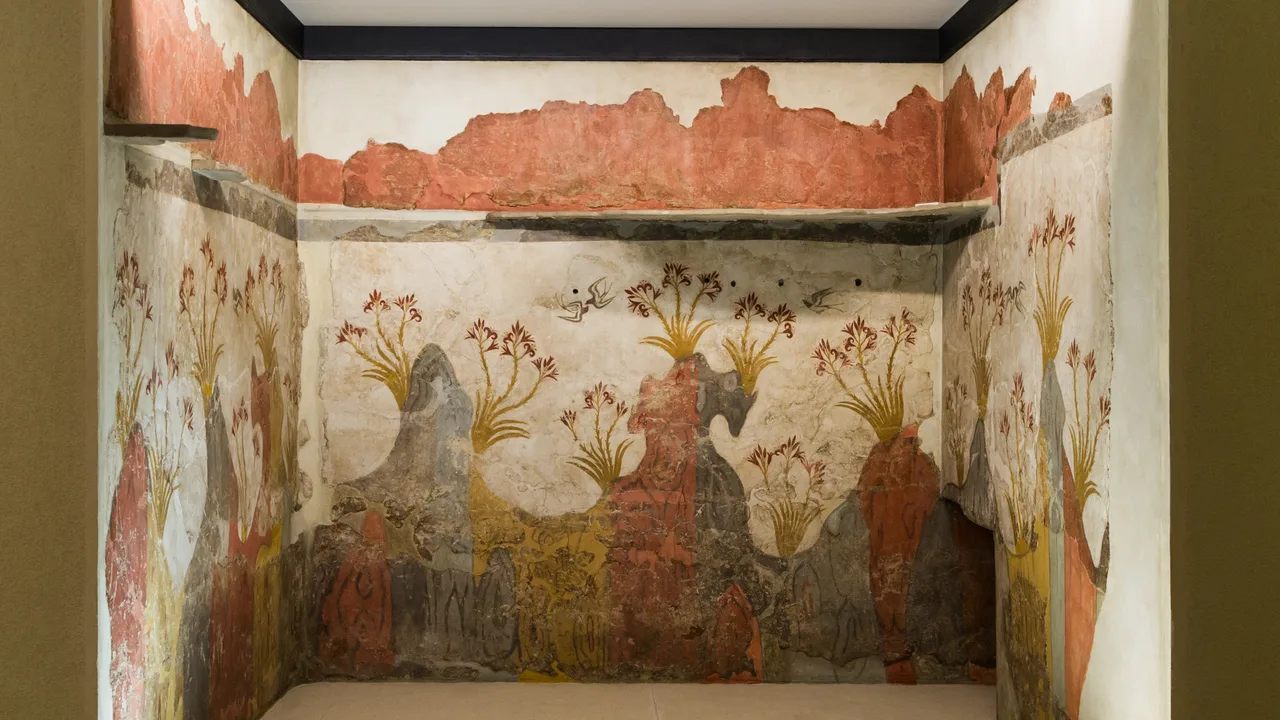
What you won't see in place are the famous frescoes, the wall paintings of spring lilies, blue monkeys, boxing boys and a fleet of ships. Most were lifted for conservation and are displayed in the Museum of Prehistoric Thera in Fira, so a complete Akrotiri visit really means two stops: the site here in the south, and the museum up in the caldera capital. A few reproductions and interpretive panels on site help you picture how the rooms looked when they were painted.
It helps to know why Akrotiri matters before you go. This was a wealthy, cosmopolitan port town of the Bronze-Age Aegean, trading with Minoan Crete, mainland Greece, Egypt and the Near East. The scale of its houses, indoor plumbing and painted walls speaks to a society far more sophisticated than "prehistoric" suggests, and its sudden burial gives archaeologists a rare frozen snapshot of daily life around 1600 BC. The eruption that entombed it, a VEI-7 blast that hurled out tens of cubic kilometres of rock and ash, one of the largest in human history (on the scale of Tambora in 1815), reshaped the whole island into the caldera you see today, and some scholars have even linked the catastrophe to the later legend of Atlantis. You're standing, in other words, at the source of Santorini's entire dramatic geology.
Plan on roughly 45 minutes to an hour and a half at the site depending on how much you read. There's little shade outside the roofed area and limited facilities, so bring water. Renting an audio guide or joining a short guided tour is worth it here, without context the ruins are impressive but hard to read.
The Museum of Prehistoric Thera in Fira is the other half of the story, and skipping it leaves the visit oddly incomplete. It's a small, modern, air-conditioned museum holding the excavation's greatest treasures: the delicate wall paintings, elegant painted pottery, gold jewellery and everyday objects that make the empty rooms at Akrotiri come alive. Its single most precious object is the gold ibex, a small gold wild goat cast by the lost-wax method in the 17th century BC and found in near-perfect condition in 1999, sealed inside a wooden box packed with animal horns, most likely a votive offering deliberately left behind; it's among the finest pieces of Aegean Bronze-Age goldwork to survive. Seeing the Spring Fresco, a wall of red lilies and swooping swallows, and then picturing it back on a wall you walked past in the south is what turns two separate stops into a single, memorable day. If you can only fit one and you're already up in the caldera, the museum is the more rewarding hour; if you're in the south with a car, do both. On its own the museum is about €10 (€5 reduced; or free on the €15 combined ticket), open roughly 08:30–15:30 and closed on Tuesdays, handy to know, since Akrotiri instead keeps its shorter hours on Mondays and Thursdays, so the two never shut on the same day.
2026 entry fees and opening hours
Santorini's museum and archaeological-site fees were revised in late 2025, so older guidebooks will quote lower numbers. As of 2026 the standard Akrotiri ticket is around €20 (roughly €10 reduced, with free or discounted entry for under-18s and EU under-25s. Bring ID). Resellers that bundle an audio guide or skip-the-line entry charge more, so compare the on-site state price against what a platform lists.
| Ticket | Covers | Indicative 2026 price |
|---|---|---|
| Akrotiri single | The excavation site only | ~€20 (reduced ~€10) |
| Multi-site package | Akrotiri + Ancient Thera + Museum of Prehistoric Thera + more | ~€15, 3-day (reduced ~€7.50) |
That package is the counterintuitive bit worth a double-take: the multi-site 3-day combined ticket is around €15, cheaper than the single Akrotiri entry, so if you also plan to visit Ancient Thera and the Museum of Prehistoric Thera, ask specifically for the combined package at the ticket desk. Because prices and package terms shifted so recently, treat these as indicative and confirm the current rate on arrival. Hours run roughly daily 08:00–20:00 in high summer, with shorter hours (about 08:30–15:30) on some weekdays, and the site has occasionally closed for structural inspections, so check before making a special trip.
How to reach Akrotiri from Perissa
Akrotiri village sits on the southwestern tip of the island, and there's no coast road linking it directly to Perissa, so every route runs via the interior.
By car or taxi it's the simplest: roughly a 20–30 minute drive from Perissa, and you pass close to the Red Beach and White Beach and the old lighthouse, easy to string together into one southern loop. There's parking near the site entrance. If you're relying on the bus, the KTEL network is hub-and-spoke: take the bus from Perissa to Fira (~25 min, ~€2.70), then change onto the Fira–Akrotiri service. It works, but the connection and the limited Akrotiri timetable make it a slower half-day, so many visitors rent a car or share a taxi for the south.
Because the south of the island packs several sights into a small area, Akrotiri is best treated as the anchor of a half-day southern loop rather than a standalone errand. A sensible order is the covered excavation first thing (before the midday heat and the tour groups), then the short drive to the Red Beach for a look and a swim, and the lighthouse at the very tip for the views back across the caldera. With your own wheels the whole circuit is comfortably done in a morning, leaving the afternoon free for Perissa's own black-sand beach. Bring water, sun cover and sturdy shoes. The site's walkways are shaded but the surrounding area is exposed and rocky.
For where this fits in a wider plan, see our best day trips from Perissa, the companion Ancient Thera guide for the island's other archaeological site right above Perissa, and the Red Beach guide for the volcanic cove next door. To book a guided Akrotiri visit, compare options on GetYourGuide's Santorini page.
Frequently Asked Questions
How much does it cost to visit Akrotiri in 2026?
The standard ticket is around €20 (roughly €10 reduced), after fees were revised in late 2025. A multi-site 3-day package covering Akrotiri, Ancient Thera and the Museum of Prehistoric Thera is around €15, cheaper than the single Akrotiri entry, so ask for it at the desk. Confirm current rates on arrival.
Who discovered Akrotiri?
The modern excavation was begun in 1967 by the Greek archaeologist Spyridon Marinatos, who uncovered the Bronze-Age town preserved under the volcanic ash. He died in an accident at the site in 1974 and is buried just beyond the ruins, where his grave can still be seen.
Where are the Akrotiri frescoes?
Most of the famous wall paintings, the spring lilies, blue monkeys and ship fresco, were removed for conservation and are displayed in the Museum of Prehistoric Thera in Fira, not at the excavation. To see both the town and its art, plan two stops: the Akrotiri site in the south and the museum in the caldera capital.
How do I get to Akrotiri from Perissa?
By car or taxi it's roughly a 20–30 minute drive via the island interior, passing near the Red and White beaches. By public transport, take the KTEL bus from Perissa to Fira (~25 min, ~€2.70) and change to the Fira–Akrotiri bus. The bus connection is slower, so many visitors drive.
Is Akrotiri worth visiting?
Yes, especially if you like history or want a shaded midday option. Because the eruption sealed the town in ash, you walk past streets and multi-storey houses that survive far better than most Bronze-Age sites. It pairs well with the nearby beaches and, up in Fira, the frescoes in the Museum of Prehistoric Thera.