The Santorini bus network is cheap, reasonably frequent in summer, and, once you understand one rule, genuinely easy to use. That rule: everything runs through Fira. The island's KTEL buses work as a hub-and-spoke system centred on Fira's central station, with no direct links between the outlying villages, so almost every journey is either to Fira or via Fira. Get that, and the rest is straightforward. This guide covers the routes, indicative 2026 fares, how you pay, frequency and last buses, and the one frustration to plan around: there's no reliable online timetable.
TL;DR: Santorini buses at a glance
| Question | Short answer |
|---|---|
| Who runs them | KTEL, the public bus company |
| The hub | Fira, nearly every route starts and ends here |
| Fares | Roughly €1.80–3.20 one way, by distance |
| How to pay | Cash to the conductor onboard, the island buses are cash only |
| Book ahead? | No, you can't buy local bus tickets online; just board and pay |
| Timetable | No reliable online schedule, check the board at Fira station |
| Frequency | Good in summer (peak ~June–early Sept); thinner off-season and late |
How the network works: the Fira hub
Santorini's buses radiate from Fira, the caldera-rim capital, like spokes from a wheel. There is no direct service between one village and another, to get from Perissa to Oia, or Kamari to Akrotiri, you ride into Fira and change. It sounds inefficient, and for cross-island trips it adds a transfer, but it keeps the system simple: learn the routes in and out of Fira and you can reach anywhere on the island. For the two journeys Perissa visitors make most, see our Perissa to Fira and Perissa to Oia guides. The second is the classic two-leg, change-at-Fira example.
Buses are modern coaches, air-conditioned, and can get crowded at peak times. The airport, Oia-sunset and post-ferry runs especially. If a bus is full you may have to wait for the next one, so leave a buffer when it matters.
Routes and indicative fares
All fares below are one way, paid onboard, and indicative for 2026. Confirm the current price with the conductor. Prices scale with distance, roughly €1.80 to €3.20.
| Route (from Fira) | Approx. time | Indicative fare |
|---|---|---|
| Fira ↔ Perissa / Perivolos | ~25 min | ~€2.70 |
| Fira ↔ Oia | ~20 min | ~€1.80–2.20 |
| Fira ↔ Kamari | ~20 min | ~€2.00 |
| Fira ↔ Airport | ~15–20 min | ~€2.20 |
| Fira ↔ Akrotiri (Red Beach) | ~30 min | ~€2.00 |
| Fira ↔ Athinios port | ~40 min | ~€2.70 |
Night services (roughly after midnight) cost a little more, around €2.50–3.10 on the longer routes. The Athinios port buses are timed to meet ferries rather than running to a fixed clock, so they line up with boat arrivals and departures, handy when you're catching or leaving a ferry (see our Athinios port guide).
A couple of routing quirks are worth internalising. The airport bus is a short hop from Fira through Karterados and Messaria, useful, but remember that from Perissa you reach the airport via Fira, not directly, so allow for the change. The Akrotiri line serves the prehistoric site and the Red Beach on the southwest tip, though the beach itself is officially rockfall-restricted, so it's best appreciated from a boat. And for Perissa and Perivolos, the same bus serves both the long black-sand beaches, so you can hop off wherever your accommodation sits along the strip. None of these routes connect to each other without returning to Fira first. The hub rule holds without exception.
Paying, tickets and the no-timetable reality
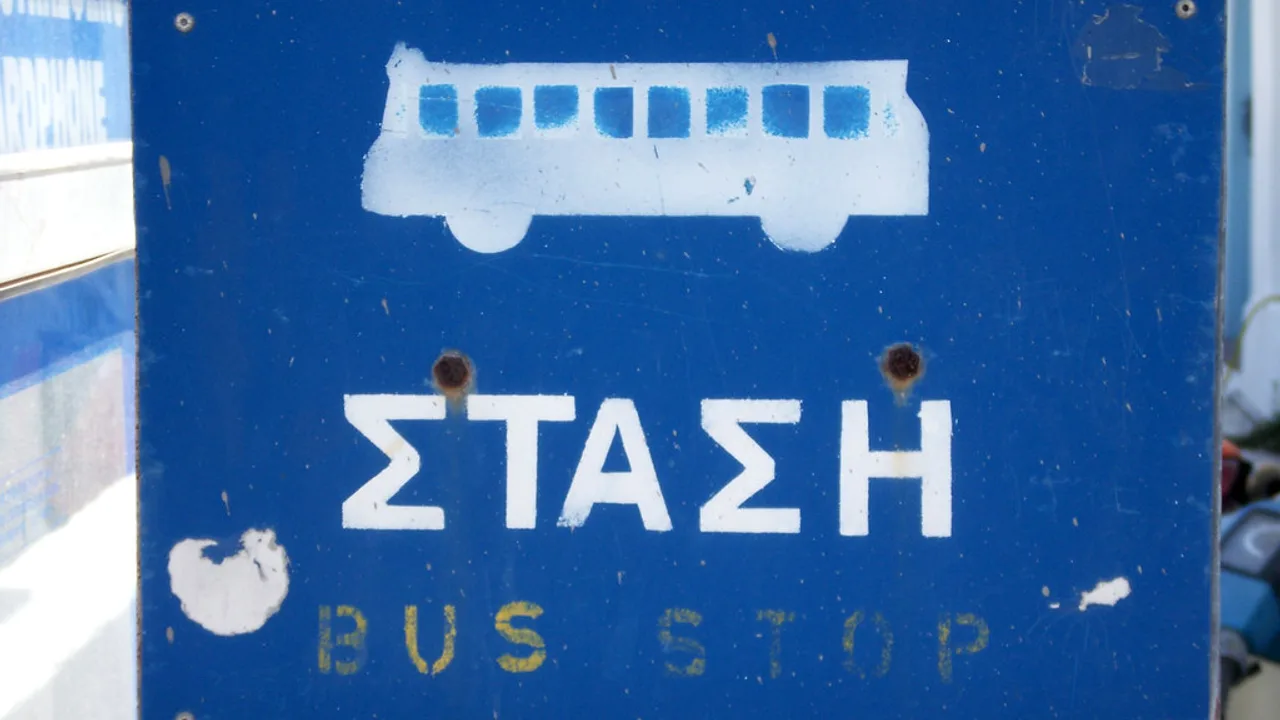
Two things surprise first-timers. First, you can't buy local bus tickets online in advance, there's no app or website booking for KTEL's island routes. You board and pay the conductor, who walks the aisle collecting fares, and Santorini's KTEL buses are cash only. Carry small notes and coins, as there are no card readers to fall back on (any tap-to-pay is at most being trialled on the newest buses, so never count on it). Second, there is no dependable online timetable. Third-party sites publish schedules, but they go out of date and frequencies change seasonally, so the reliable sources are the printed board at Fira's central bus station and the schedule posted at your local stop. Snap a photo of the board when you're at Fira.
Frequency is good in high summer. Many routes run roughly hourly or better through the day, more often on the busiest lines, and thins out in the shoulder season and late evening. Last buses are the thing to watch: services wind down in the evening, and the final departure back to Perissa or another village leaves earlier than you might expect. Always check the last bus before heading out for the evening, especially for Oia sunset, or you risk an expensive taxi back, and Santorini has few taxis, which are unmetered. That fallback is thinner than most visitors assume, so it's worth reading our Santorini taxi guide before you count on one at 11pm.
Practical tips for riding Santorini's buses
A handful of habits make the network painless:
- Carry cash in small denominations. The conductor collects fares onboard and the island buses take cash only, so coins and small notes are essential, there's no card reader to rely on.
- Photograph the Fira board. With no reliable online timetable, the printed schedule at the central station is your source of truth, snap it for return and onward times.
- Board early at busy stops. There's no reserved seating; a full bus means waiting for the next one, so arrive with a buffer for the airport, Oia and post-ferry runs.
- Plan the transfer. For any village-to-village trip you change at Fira and pay a second fare, build the wait, which can reach half an hour, into your day.
- Watch the last bus. Evening services wind down earlier than you'd expect; confirm the final departure before a night out, especially after Oia sunset.
None of this is difficult, but Santorini buses reward the prepared and punish the person who assumes an app will save them. A photo of the Fira board and a pocket of coins cover ninety percent of the friction.
When the bus isn't the answer
The bus is unbeatable value, but it isn't always the right tool. For the Oia sunset, the pre-sunset traffic clogs the road for everyone and buses fill up. Plan the timing carefully. For flexibility, luggage, or reaching quieter spots off the main routes, renting an ATV or car sidesteps the whole hub-and-change system; our ATV and car rental guide covers prices and licence rules. And for getting to the island in the first place, our getting to Perissa guide and the /getting-here page cover the airport and ferry connections, while /practical-info rounds up cash and everyday basics.
Once you're in the hub, our Fira guide covers the town itself, the caldera views, the old-port cable car, and where to pause between buses.
Frequently Asked Questions
How much are buses in Santorini?
Fares are roughly €1.80 to €3.20 one way in 2026, scaling with distance, around €2.70 for Fira–Perissa, ~€2.20 for Fira–Oia and the airport, and a similar hop to Fira–Kamari. You pay the conductor onboard in cash, Santorini's buses don't take cards, so carry small notes and coins. Night services (roughly after midnight) cost a little more, around €2.50–3.10 on the longer routes.
Do Santorini buses run on a schedule I can check online?
Not reliably. There is no dependable online timetable for KTEL's island buses, third-party schedules go out of date and frequencies change seasonally. The trustworthy sources are the printed board at Fira's central bus station and the schedule at your local stop. Photograph the Fira board so you have return times to hand.
Can I buy Santorini bus tickets in advance?
No. Local KTEL buses can't be booked online or via an app. You simply board and pay the conductor, who collects fares along the aisle. You must pay in cash (small notes and coins), Santorini's island buses don't accept cards. There's no reserved seating, so at peak times a full bus means waiting for the next one.
Why do all Santorini buses go through Fira?
Santorini's network is hub-and-spoke, with Fira as the hub. There are no direct routes between outlying villages, so any cross-island trip, say Perissa to Oia, means riding into Fira and changing to a second bus, paying two fares. It's the system's one quirk; learn the routes through Fira and you can reach the whole island.
What time is the last bus in Santorini?
It varies by route and season, and there's no reliable online listing, so check the board at Fira on the day. In general, evening services wind down and the last bus back to your village leaves earlier than you'd expect. A real risk after Oia sunset. Confirm the final departure before heading out, as taxis are few and unmetered.