How do you get from the Old Port up to Fira — and is the famous Fira cable car worth the queue? For most visitors, yes: it's the quick, step-free ride up a 220-metre cliff that would otherwise mean nearly 600 steps on foot. But the queues can be brutal when a cruise ship is in, the ticketing has quirks, and the third option — the donkeys — comes with a real animal-welfare problem worth knowing before you decide. This guide covers what it costs, when it runs, how bad the lines get, and the three ways up and down. For the town itself, see our Fira Santorini guide.
The Fira cable car at a glance
| Question | Short answer |
|---|---|
| What it connects | Fira town and the Old Port (Skala) below, where cruise tenders dock |
| Cliff height | ~220 metres |
| Ticket price | ~€10 one way (adult); ~€5 child 6–12; under-6 free; luggage ~€5 |
| Return ticket? | No — sold one way only, so a round trip is two singles |
| Operating hours | Roughly 06:30–23:00 in peak summer (shorter off-season) |
| Ride time | ~2–3 minutes |
| Worst queue | Heading down in the afternoon when ships depart — up to an hour |
| The three ways | Cable car, ~588 steps on foot, or donkey (best avoided) |
Prices and hours change seasonally — treat these as 2026 figures and check the current details before you go.
What the cable car is and where it goes
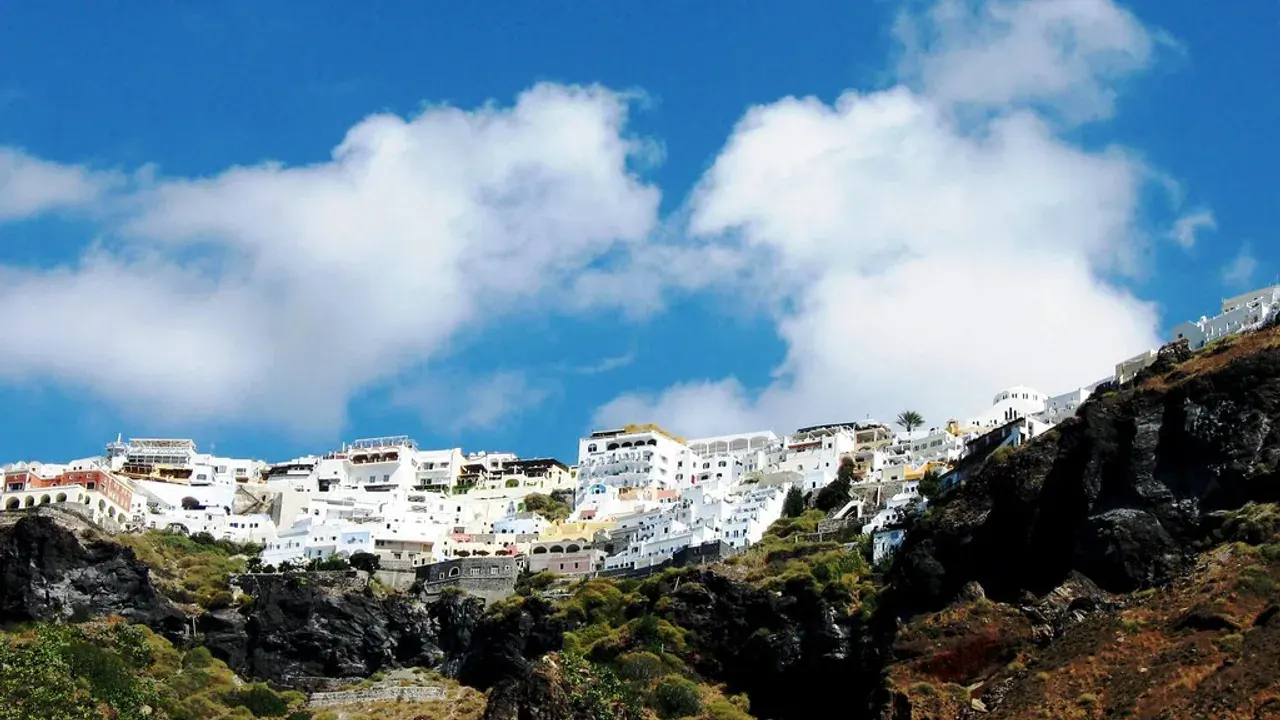
The cable car is the aerial link between Fira, Santorini's clifftop capital, and the Old Port of Fira (Skala) at the water's edge some 220 metres below. Skala is where cruise tenders come ashore — ships can't dock in the deep caldera, so they anchor in the bay and ferry passengers to this small quay — and it's also where some volcano and hot-springs boat tours depart. There is little at sea level but a strip of cafes and gift shops; the whole point of the Old Port is to get up to Fira, and the cable car is the fastest way to do it. The upper station sits right on the caldera-edge promenade in the centre of town, a short walk from the Fira shops, museums and bus terminal.
Built by the Nomikos foundation and gifted to the island, the system runs a string of small cabins up and down the cliff face continuously, each carrying a handful of passengers, with a ride of just two to three minutes. It's genuinely scenic — a straight run up the volcanic rock with the caldera opening out beneath you — and, importantly, it's the only step-free route between the port and the town, which matters if you have luggage, mobility issues or small children.
Tickets and hours
A one-way adult ticket costs around €10 in 2026, with children aged 6–12 about €5, under-6s free, and luggage roughly €5 per piece. (You may still see older figures like €6 floating around online — the current, consistently reported 2026 price is about €10, so budget for that and check the latest at the booth or official site.) Note the ticketing quirk that catches people out: the cable car is sold one way only — there is no return ticket, so a there-and-back is two separate €10 singles (about €20). Pay in cash at the booth with small euro notes, or — far better at busy times — buy online in advance via the official cable-car site and show a digital ticket to skip the payment-window queue entirely, walking straight to the boarding line.
Operating hours are long in summer — roughly 06:30 to 23:00 in peak season (last departures a little before closing), pulling back to something like 06:30–22:00 in the shoulder months and shorter still in winter. The operator often extends hours on the fly to clear late-departing cruise passengers, so nobody is stranded at the harbour, but don't rely on that — know your ship's all-aboard time and build in a buffer. Hours shift year to year, so confirm the current schedule if you're cutting it fine.
The queues — the thing nobody warns you about
Here's the catch. On a quiet day the cable car is a two-minute hop with a short wait. But a single cruise ship can land well over a thousand people, and when several are in at once the station becomes the island's chokepoint. Reported waits when ships are in port run 30 to 60 minutes, sometimes more than an hour, especially in the busy midday window of roughly 10:00–15:00.
The critical tactical point: the queue is usually worse going down in the afternoon than going up in the morning. Arrivals are staggered as ships tender passengers ashore over a couple of hours, but in the afternoon everyone tries to get back to their tender at once, and the whole crowd converges on one station. Seasoned cruise visitors deliberately ride up in the morning and walk down the steps in the afternoon, sidestepping the worst of it. If you're on a ship, plan to be at the top station well before your all-aboard time — leaving a generous margin — because a missed last tender means chasing the ship to its next port at your own expense. The 2026 daily passenger cap should ease the very worst crushes, but the afternoon bottleneck hasn't gone away. Our Santorini cruise port guide goes deeper on timing your return.
The three ways up (and down)
| Way | Cost | Time | Notes |
|---|---|---|---|
| Cable car | ~€10 one way | ~2–3 min | Fastest and only step-free option; queues at peak |
| Walk the steps | Free | ~30–40 min up, ~20–30 down | ~588 zig-zag steps, shared with donkeys, slippery |
| Donkey | Paid | ~20 min | Best avoided — documented welfare concerns |
The cable car is the obvious default: fast, scenic, step-free, and the only realistic choice if you have luggage or limited mobility — but factor in the queue.
The steps — the Karavolades stairs, famously counted at around 588 though tallies vary — zig-zag up the same cliff for free. Climbing up is a sweaty 30–40 minutes in the heat and the path is shared with donkeys, which makes it slippery and, frankly, smelly underfoot; wear proper shoes and watch your step. But walking down is far easier, about 20–30 minutes, and it's the reliable fallback when the cable-car queue is impossible — it guarantees you make your tender.
The donkeys are the third, traditional option, and the one we'd steer you away from. Animal-welfare investigations have documented overwork, oversized loads and poor conditions for the animals that carry tourists up the cliff in the heat, and several cruise lines and guidebooks now actively discourage the rides. The steps or the cable car do the same job without the ethical cost — a straightforward call for most visitors.
Doing it as a Perissa day-tripper
If you're staying on the black-sand side and heading over for a caldera day, you don't need the cable car at all to reach Fira — the KTEL bus from Perissa drops you in the town centre, up top, in about 25 minutes for a couple of euros (see our Perissa to Fira route guide). You'd only ride the cable car if you want to go down to the Old Port — to catch a volcano boat tour, or simply for the ride and the view — and then back up. In that case the same rules apply: two one-way tickets, and mind the afternoon queue back up. Many day-trippers ride down for a boat tour and, if the return line is long, walk the steps back up rather than wait.
For the wider caldera loop — Fira, the museums, and on to Oia for sunset — our Fira guide and Oia Santorini guide map out a full day, and the cable car slots in as one scenic, optional leg rather than something you're obliged to queue for.
Frequently Asked Questions
How much is the Fira cable car?
A one-way adult ticket is around €10 in 2026, with children 6–12 about €5, under-6s free, and luggage roughly €5 per piece. It's sold one way only — there's no return ticket — so a round trip is two singles (about €20). You may see older €6 figures online, but the current reported price is about €10; buy online in advance to skip the payment queue, or pay cash at the booth.
What does the Fira cable car connect?
It links Fira town to the Old Port (Skala) directly below it, dropping about 220 metres down the caldera cliff in a two-to-three-minute ride. The Old Port is where cruise tenders dock and some volcano boat tours leave, so the cable car is the main step-free way between the port and the town.
How long is the queue for the Santorini cable car?
On quiet days it's a short wait, but when cruise ships are in port queues can run 30–60 minutes or more, worst in the midday window. The heaviest crush is usually heading down in the afternoon, when everyone returns to their tender at once, so cruise passengers should allow a generous buffer or walk the steps down instead.
How many steps are there instead of the cable car?
The Karavolades stairs are commonly counted at around 588 steps, climbing the same 220-metre cliff. Walking down takes about 20–30 minutes; climbing up is a harder 30–40 minutes and the path is shared with donkeys. The steps are a dependable fallback when the cable-car line is long, especially heading back to a ship.
Should I ride the donkeys up to Fira?
We'd avoid them. Animal-welfare investigations have documented overwork and poor conditions for the donkeys that carry tourists up the cliff, and several cruise lines now discourage the rides. The cable car (step-free) or the steps (free) get you up without the ethical concern.