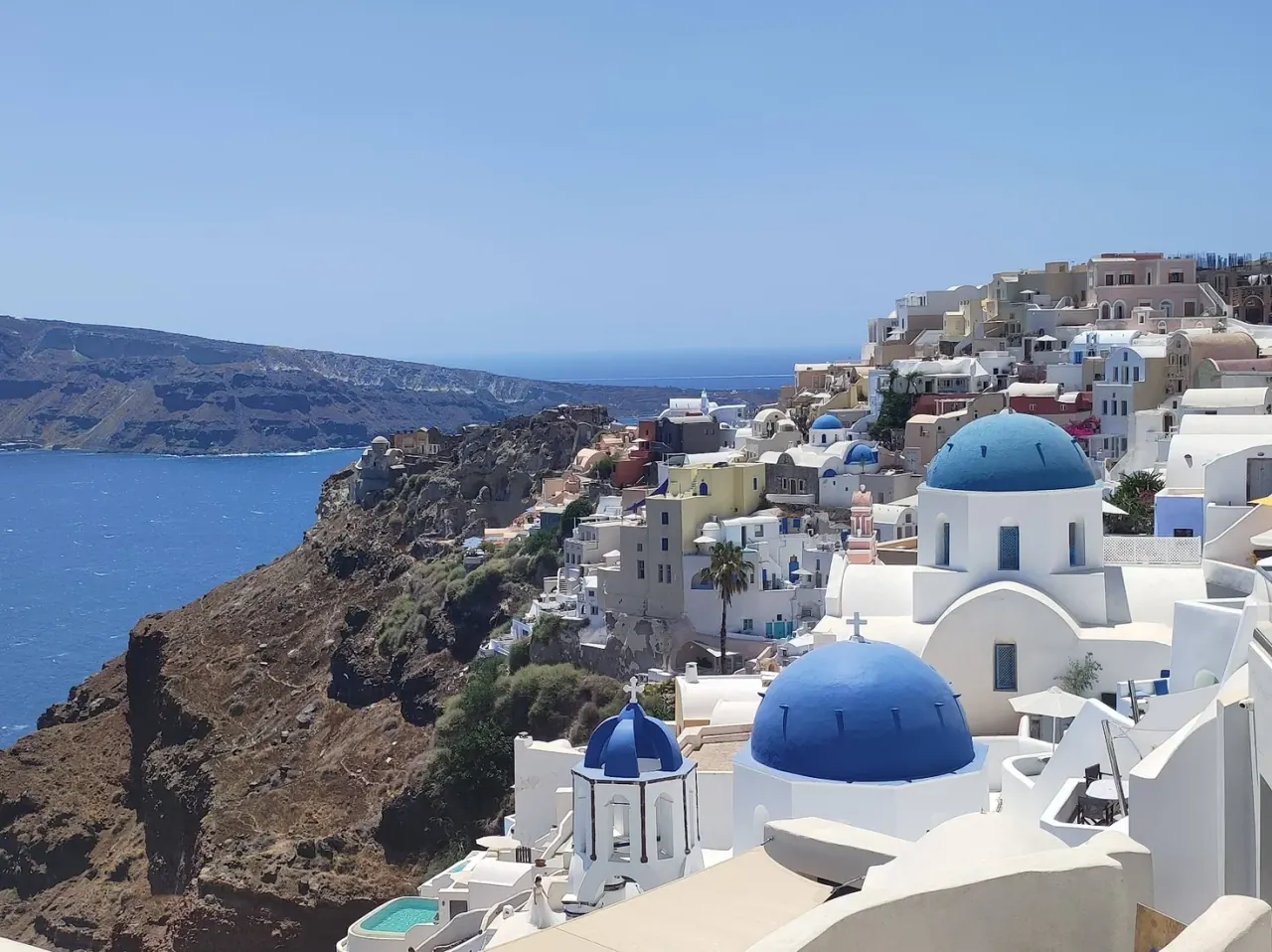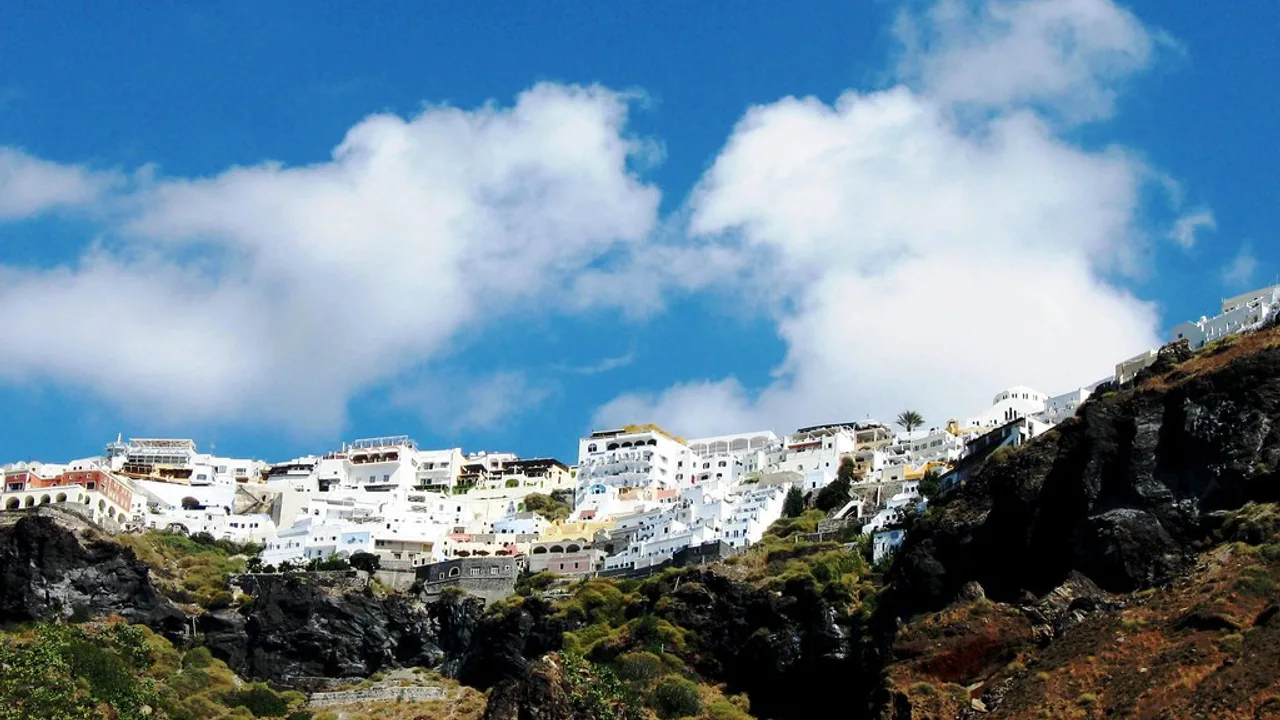
Arriving in Santorini by cruise ship is unlike any other port in the Mediterranean: there's no dock. The caldera is a flooded volcanic crater far too deep for ships to tie up, so vessels anchor in the bay and ferry you ashore by tender to the Old Port of Fira (Skala). A tiny quay at the foot of a 220-metre cliff. From there you still have to get up to Fira town, which is where the famous cable car, the 588-odd steps and the donkeys come in. This Santorini cruise port guide explains how the tender works, your options up the cliff, what excursions make sense in a port day, and, most importantly, how to get back to your ship on time.
TL;DR: the Santorini cruise port at a glance
| Question | Short answer |
|---|---|
| Where do ships dock? | They don't, ships anchor in the caldera and tender you to Fira Old Port |
| Tender time | ~10 minutes across the bay to the Old Port (Skala) |
| Getting up to Fira | Cable car (~€10), ~588 steps on foot, or donkey (skip on welfare grounds) |
| Cliff height | ~220 metres from the Old Port up to Fira town |
| Big risk | The cable-car queue back down, return early |
| Athinios vs Old Port | Cruise tenders mainly use the Old Port; for 2026 up to 30% are directed to Athinios, the car-ferry port |
How you actually get ashore
Because the caldera is so deep, cruise ships anchor offshore and run their own tenders (or contracted local boats) to the Old Port, a roughly 10-minute ride across the bay. The Old Port, also called Skala, is a small strip of quay, cafes and gift shops directly below Fira. There is nothing much to do at sea level itself; it's purely the gateway up.
Tendering means timing is set by your ship, not you. Ships hand out tender tickets, and getting back on the last tender before all-aboard is entirely your responsibility. It also means a rough day can disrupt or cancel tendering. The caldera is usually calm, but strong winds occasionally force ships to skip Santorini or cut the call short. Book independent plans with that small risk in mind.
There's a rhythm to a Santorini port morning worth knowing. Ships on guided excursions usually tender their passengers first, so independent travellers can face a wait for a tender ticket in the first hour, and then meet the same crowd again at the cable car. If you can, get ashore either very early or let the first surge clear, and you'll spend far less of your day standing in lines. The Old Port itself has a handful of cafes and souvenir shops if you're waiting, but it's cramped and touristy; the reason you're here is up top.
Note the difference between the two ports: the Old Port (Skala) is the main gateway for cruise tenders, while Athinios, a few kilometres south, is the car-ferry port for inter-island ferries, the one you'd use arriving from Athens or another island. From 2026, though, a share of cruise passengers is also directed to Athinios (see the daily-cap section below), so which port you land at depends on your ship.
Getting from the Old Port up to Fira
From the Old Port you climb about 220 metres up the cliff to Fira town. There are three ways, and the choice matters more than it sounds because of the queues.
| Way up | Cost | Time | Notes |
|---|---|---|---|
| Cable car | ~€10 one way | ~2–3 min ride | Fastest; but long queues, especially back down |
| Walk the steps | Free | ~30–40 min | ~588 zig-zag steps, shared with donkeys, slippery |
| Donkey | Paid | ~20 min | Skip it, documented animal-welfare problems |
The cable car is the obvious choice: cabins run every few minutes and the ride up the cliff face takes only a couple of minutes. Expect a queue, because a single ship can land well over a thousand people, but you can now buy tickets in advance on the official site (tickets.santorinicablecar.gr) and show a digital ticket to skip the payment-window line, or bring small euro notes to pay at the booth. The Karavolades steps, the famous count is 588, though tallies vary, are free and quick to descend but a sweaty, donkey-shared 30–40 minute climb up. We'd avoid the donkey rides entirely: welfare investigations have documented overwork and poor conditions, and several cruise lines now discourage them.
A tactical point most first-timers miss: the cable car is your friend going up in the morning, when arrivals are staggered, but it's the day's chokepoint going down in the afternoon, when everyone heads back at once. Many seasoned cruisers deliberately ride up and walk down, sidestepping the worst queue entirely. If you have any mobility issues the walk isn't realistic in either direction. The cable car is the only step-free route up, as our accessible Santorini guide explains, so factor the cable-car wait into your return timing rather than assuming a quick hop back to the tender.
Excursions and how to spend a port day
A Santorini port call is short, often six to eight hours ashore, so pick one focused plan, not five. Realistic options:
- Fira + Oia on your own. Cable car up, explore Fira, then bus or taxi to Oia and back. Doable but tight; our one day in Santorini itinerary is built for exactly this.
- A caldera boat tour. Some volcano and hot-springs cruises leave from the Old Port itself, so you barely move. See our volcano boat tour guide. Compare sailings on GetYourGuide's Santorini page.
- A ship or private excursion. Pricier, but a ship-run tour guarantees the boat won't leave without you, and a private driver skips the bus juggling.
Whatever you choose, keep the return in view. For the difference between the two arrival points, our Athinios port guide and the /getting-here page explain how the ferry port works, and the /day-trips page lists what's reachable in a short window. Skip trying to add Akrotiri, wineries and a beach, a port day doesn't stretch that far.
A word on the perennial cruise-passenger question of doing it yourself versus booking through the ship. Independent plans are cheaper and more flexible, and Santorini is genuinely easy to explore on your own. The cable car, buses and taxis are all straightforward. The trade-off is risk: if a self-organised boat or bus runs late and you miss the last tender, the ship leaves without you and getting to the next port is your problem and your bill. A ship-run excursion costs more but is guaranteed to be back on time, which buys real peace of mind on a tight schedule. For most confident travellers the independent route wins; for anyone anxious about the clock, or calling on a short port day, the organised tour is money well spent.
Getting back to your ship on time
This is where port days go wrong. The cable-car queue going back down to the Old Port is usually worse than going up. A single afternoon can see every ship's passengers converging on one station at once, and a 15-minute queue can become an hour. Plan to be back at the top station at least 90 minutes before your ship's all-aboard time, more if several ships are in.
If the queue looks impossible, the steps are your fallback, walking down is far easier than up, about 20–30 minutes, and guarantees you make the tender. Independent travellers should always leave a generous buffer, because a missed last tender means chasing the ship to its next port at your own expense. Ship-organised excursions remove that risk, which is part of what you pay for.
The cruise passenger tax and daily cap
Two overtourism measures now shape a Santorini cruise call. Since 2025 Greece charges a cruise passenger tax, €20 per person in peak season (June–September), about €12 in the shoulder months and €4 in winter, with Santorini and Mykonos set at these top rates (other Greek ports are €5/€3/€1). It's collected through the cruise line, so it normally appears in your fare or port charges rather than being paid at the quay.
Santorini also enforces a daily cap of 8,000 cruise passengers, introduced in 2025 and tightened for 2026 (ship loads are now counted at full occupancy). The cap trims how many ships can call on the busiest days, a nuisance if it forces a last-minute itinerary change, but a real improvement for the crush ashore when it holds.
New for 2026, the port authority also spreads arrivals across both ports to ease the cable-car bottleneck: up to 70% of a ship's passengers come ashore at the Old Port below Fira, and up to 30% are directed to Athinios, the car-ferry port a few kilometres south. Which one you land at is set by your ship, so check your cruise line's port information, if you're sent to Athinios you'll reach Fira or your excursion by road rather than by cable car. Rates and rules are being adjusted year to year, so treat these as 2026 figures and check the latest before you sail. Our guide to the 2026 Santorini cruise rules unpicks the cap and the tax in more detail, and what each means for your port day.
Frequently Asked Questions
Where do cruise ships dock in Santorini?
They don't dock. The caldera is too deep, so ships anchor in the bay and tender passengers ashore, mainly to the Old Port of Fira (Skala), about a 10-minute ride. From the Old Port you reach Fira town 220 metres above by cable car, on foot up the steps, or by donkey. New for 2026, up to 30% of each ship's passengers are instead directed to Athinios (the car-ferry port south of town), from where you continue by road, which port you use is set by your cruise line. Rough weather can occasionally disrupt tendering.
How much is the cable car from the Santorini cruise port?
The cable car between the Old Port and Fira costs around €10 one way for adults (about €5 for children 6–12, under-6s free), with cabins running every few minutes and a ride of just a couple of minutes. Buy in advance on the official site (tickets.santorinicablecar.gr) to skip the ticket-window queue, or bring small euro notes for the booth, either way expect a boarding queue when ships are in, as the line back down to the port in the afternoon is typically the worst bottleneck of the day.
How many steps are there from the Old Port to Fira?
The Karavolades stairs are commonly counted at around 588 steps, climbing roughly 220 metres up the cliff. Walking down takes about 20–30 minutes; climbing up takes 30–40 and is shared with donkeys. The steps are a reliable fallback when the cable-car queue is long, especially heading back to your tender.
How early should I head back to the ship in Santorini?
Aim to be at the cable-car top station at least 90 minutes before all-aboard, and earlier if multiple ships are in port, because the downhill queue is the main risk. If it's backed up, walk down the steps (about 20–30 minutes) instead. Independent travellers should always leave a generous buffer over a ship-run excursion.
Is there a cruise tax for Santorini?
Yes. Since 2025 Greece levies a cruise passenger tax of about €20 per person in peak season (June–September), €12 in the shoulder months and €4 in winter at Santorini, normally collected through your cruise line rather than paid at the port. Santorini also caps cruise arrivals at 8,000 passengers a day, tightened for 2026 to ease peak-day crowding. Treat these as current figures and check the latest before you travel.