Do you need a Santorini eSIM, or will your phone just work when you land? The honest answer depends entirely on where your number is from. Greece is a full European Union member, so an EU or EEA SIM roams here at no extra cost — but a UK, US, Australian or other non-EU phone can rack up steep roaming bills unless you plan ahead. This guide sorts out who needs what, what a travel eSIM costs in 2026, how coverage holds up around Perissa and the caldera, and exactly how to set an eSIM up before you fly. For the rest of the arrival logistics, see our getting to Perissa guide.
Getting online in Santorini at a glance
| You're travelling on a… | What to do | Rough cost |
|---|---|---|
| EU / EEA number (incl. Greece) | Nothing — roam like at home | Your normal home plan |
| UK number (post-Brexit) | Check your carrier; buy an eSIM if it charges | Free or ~£2–5/day, or eSIM |
| US / Canada / Australia / other | Travel eSIM or local SIM | eSIM from ~€2–16 |
| Heavy data user / hotspot | Travel eSIM on Cosmote or a local prepaid SIM | ~€10–20 for the trip |
| Just want hotel Wi-Fi | Rely on accommodation and cafe Wi-Fi | Free, but patchy on the move |
The one rule that decides everything: is your SIM from the EU?
Greece is in the EU and the Eurozone, and that single fact changes the whole calculation. Under the EU's "roam like at home" rules, anyone with a SIM issued in an EU or EEA country uses their domestic allowance of calls, texts and data in Greece at no surcharge — the same bundle you'd use in Paris, Dublin or Berlin works identically in Perissa. The scheme has been extended to run to 2032, and for 2026 it covers the 27 EU states plus Iceland, Liechtenstein and Norway (with Moldova and Ukraine added at the start of the year). If your number is from any of those, stop reading and just pack your charger — you're sorted, subject only to your plan's "fair use" data cap for roaming, which is worth checking if you burn through a lot of gigabytes.
This is the crucial difference from the Western Balkans. On the Albanian Riviera or in Montenegro, EU roaming does not apply and travellers reach for an eSIM by default — but Santorini is EU territory, so EU roaming very much does apply here. Don't let advice written for non-EU Mediterranean destinations talk you into buying data you already have for free.
The UK grey area after Brexit
The UK is the awkward middle case. Since Brexit, Britain is no longer covered by "roam like at home," so there's no legal guarantee of surcharge-free use — but the reality is more nuanced than the headline suggests. Some UK networks (reportedly the likes of O2 and Virgin) have voluntarily kept EU roaming free, while others (reportedly EE and Three) have reintroduced daily fees, typically in the region of a few pounds a day, sometimes with a fair-use data cap. Rates and which-carrier-does-what change from year to year, so check your specific tariff before you fly — the roaming section of your carrier's app or website will tell you the current daily charge and any data limit. If your carrier still bundles Europe free, you're effectively in the EU camp; if it charges £2–5 a day, a one-off travel eSIM for a week-long trip often works out cheaper and avoids bill shock.
For US, Canadian, Australian and other non-EU travellers
If your number is from outside Europe, default roaming is usually expensive and metered, so the sensible move is either a travel eSIM bought before you land or a local Greek SIM picked up on arrival.
A travel eSIM is the path of least resistance in 2026. It's a digital SIM you buy online, install by scanning a QR code, and activate the moment you land — no shop, no queue, no swapping the tiny plastic card. Providers such as Airalo, Saily, Nomad and Holafly all sell Greece or Europe-wide plans; Airalo's Greek data typically rides on the Cosmote network (the strongest on the islands), while Holafly leans on Vodafone/Nova and sells unlimited plans, though its unlimited tier historically doesn't allow hotspot tethering, so check that if you need to share to a laptop. Your phone must be eSIM-compatible and carrier-unlocked — most iPhones from the XS onward and recent Pixel and Samsung flagships qualify, but verify before you pay.
A local prepaid SIM from Cosmote, Vodafone Greece or Nova is the alternative, sold at airport kiosks, network stores and many mini-markets. It can be better value for a longer stay or very heavy use, and gives you a Greek number, but it means finding a shop and showing ID (Greece requires registration of prepaid SIMs), which eats into holiday time. For a short island trip, most non-EU visitors find the eSIM simpler.
What a travel eSIM actually costs in 2026
Prices move constantly and vary by provider, so treat these as ballpark figures and check the current rate when you buy. As a rough guide for 2026, Greece and Europe-wide eSIM plans start around €1.99 for a small 1 GB / 7-day bundle and climb to roughly €15–16 for a 20 GB / 30-day plan, with mid-size options (5–10 GB for a week or two) landing somewhere in between — the sweet spot for a typical Santorini holiday of heavy map, message and photo-upload use but light video. Unlimited plans cost more and suit streamers. By comparison, paying your home carrier's roaming rate — reportedly €6–12 a day for some non-EU and charging UK plans — adds up fast over a week, which is exactly why the eSIM exists. Estimate your real usage (maps, WhatsApp and the odd upload are frugal; Netflix on the beach is not) and buy one size up rather than running dry mid-trip.
Coverage around Perissa and the caldera
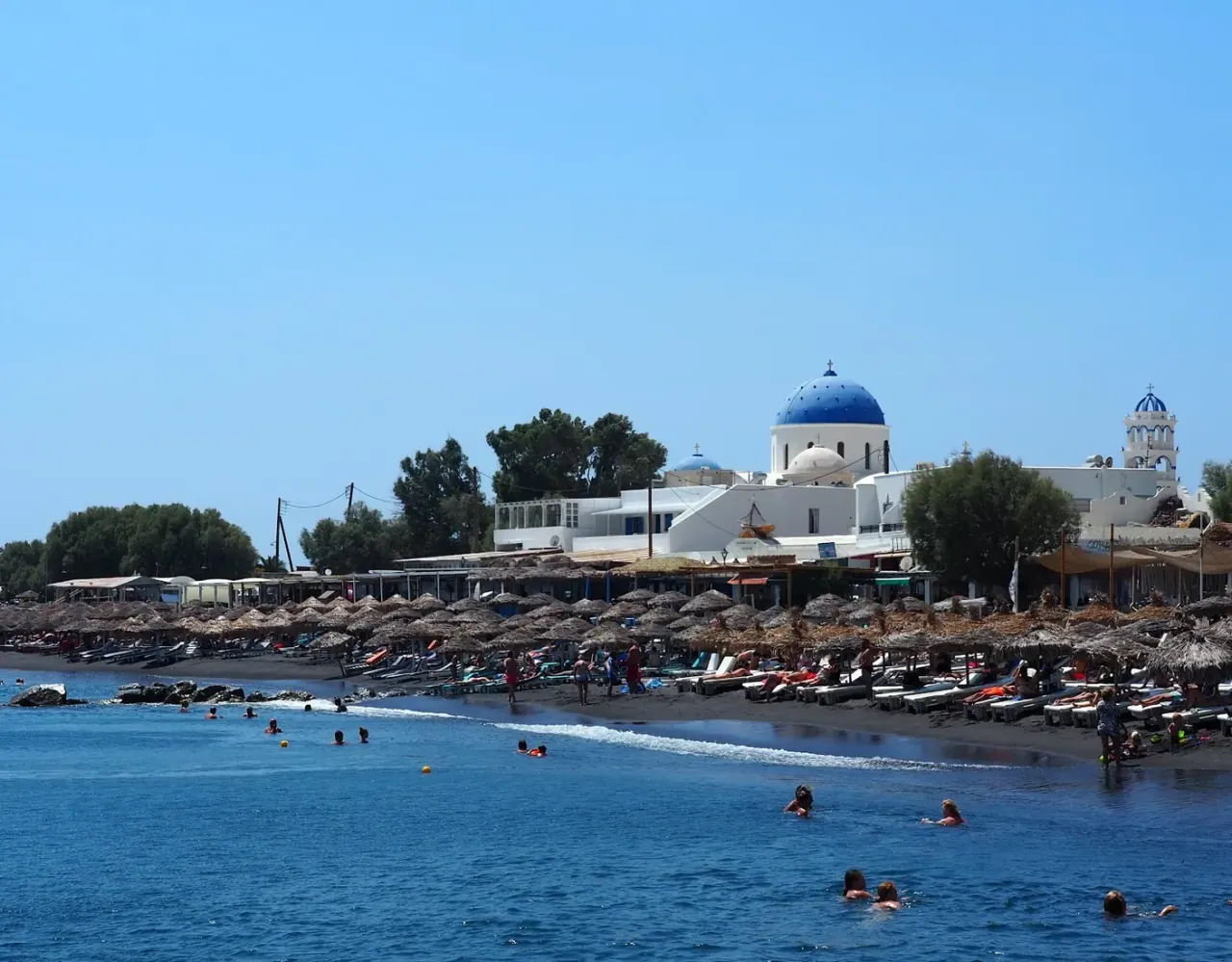
Santorini is small and well-served: expect solid 4G/LTE, and 5G in the main areas, across Fira, Oia, Akrotiri and the beach villages including Perissa and Perivolos, on both Cosmote and Vodafone. Cosmote is generally reckoned to have the best island coverage and the fastest average speeds, which is why so many travel eSIMs route through it; Vodafone Greece is a close second and Nova a step behind. In practice you'll have a strong signal on the black-sand beach, in the tavernas and along the main roads.
The caveat is the caldera's dramatic geography. Signal can be patchy in pockets right on the cliff and caldera edges — deep in the stepped lanes below the rim, on some of the coastal boat tours, and in the lee of the big rock of Mesa Vouno behind Perissa — where the terrain simply blocks the towers. It's rarely a dead zone for long, but don't be surprised if a bar or two drops out at a dramatic viewpoint. Download offline maps and any ferry or bus tickets before you set off, and you'll never be caught out. Hotel, villa and cafe Wi-Fi is widespread and usually free across Perissa, so for light users who mostly need data at their accommodation, that alone may cover the trip.
Setting up an eSIM, step by step
The process is genuinely quick, but do the buying part at home on Wi-Fi before you travel — you'll want a connection to download the profile, and it's smoother than fumbling at the airport.
- Check compatibility. Confirm your phone is eSIM-capable and unlocked (Settings will show an "Add eSIM" or "Add cellular plan" option if so).
- Buy the plan from your chosen provider's app or site, picking a data size one notch above your honest estimate.
- Install the profile by scanning the QR code the provider sends, or via in-app one-tap install — this can be done days ahead; most plans only start counting once you arrive and connect, but confirm the activation terms.
- On arrival, set the eSIM as your data line and, importantly, turn OFF data roaming on your primary home SIM so it can't quietly rack up charges in the background. Keep the home SIM active only for calls or texts you need on your usual number.
- Toggle data roaming ON for the eSIM itself (a travel eSIM technically "roams" onto the local network, so this switch needs to be on for the eSIM line even though it's the whole point of the plan).
That's it — you'll be online within a minute of landing at Thira airport or stepping off the ferry at Athinios.
Frequently Asked Questions
Do I need an eSIM for Santorini?
Only if your phone number is from outside the EU/EEA. Greece is in the EU, so EU and EEA SIMs roam free under "roam like at home." Travellers from the US, Australia, Canada and other non-EU countries — and UK visitors whose carrier now charges for Europe — benefit from a travel eSIM (Airalo, Saily, Nomad) or a local Greek SIM to avoid expensive roaming.
Does EU roaming work in Santorini?
Yes. Santorini is Greek and therefore EU territory, so "roam like at home" applies — an EU or EEA SIM uses its normal domestic allowance here at no surcharge, unlike in non-EU spots such as Albania or Montenegro. The rules are set to run to 2032 and cover the 27 EU states plus Iceland, Liechtenstein and Norway, subject to your plan's fair-use data cap.
Will my UK phone work in Greece without extra charges?
It depends on your carrier. Since Brexit the UK is no longer in "roam like at home," so there's no guarantee. Some networks kept EU roaming free voluntarily; others reintroduced daily fees of roughly £2–5. Check your specific tariff before you travel — if it charges, a one-off travel eSIM for the trip is often cheaper.
How much does a Santorini eSIM cost?
Prices vary by provider, but in 2026 Greece and Europe eSIM plans start around €1.99 for 1 GB over 7 days and reach roughly €15–16 for 20 GB over 30 days, with mid-size plans in between. Check the current rate when you buy, and pick a size above your honest usage estimate.
Is there good mobile coverage in Perissa?
Yes — Perissa, Perivolos and the main island towns have strong 4G/LTE and 5G on Cosmote and Vodafone, the two networks most travel eSIMs use. Signal can be patchy right on the caldera cliff edges and behind Mesa Vouno, so download offline maps and tickets before you set out. Free Wi-Fi is widespread in hotels and cafes.