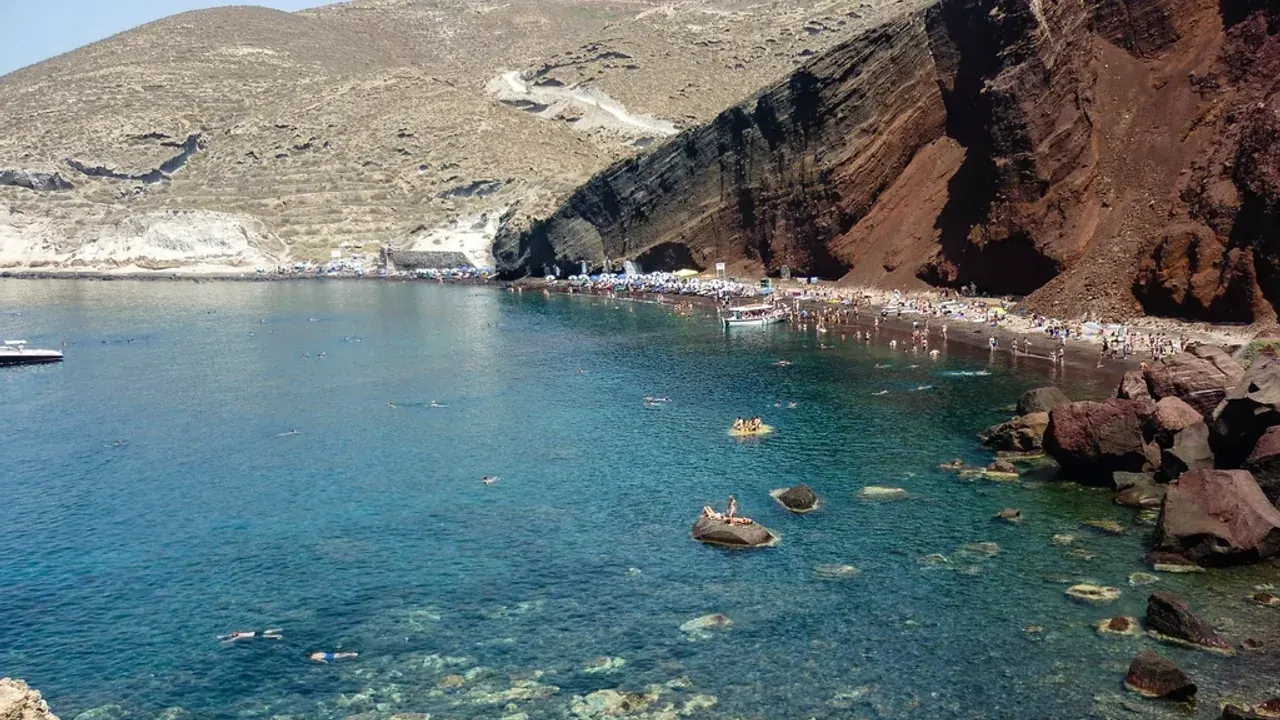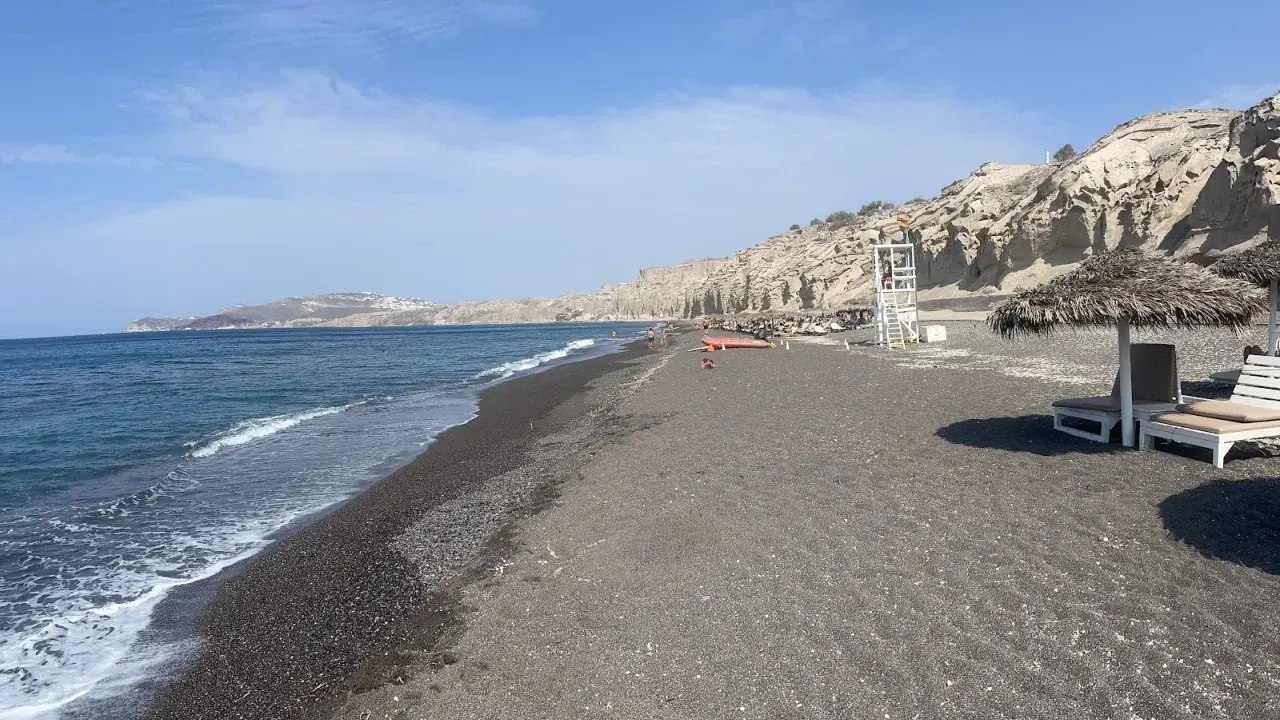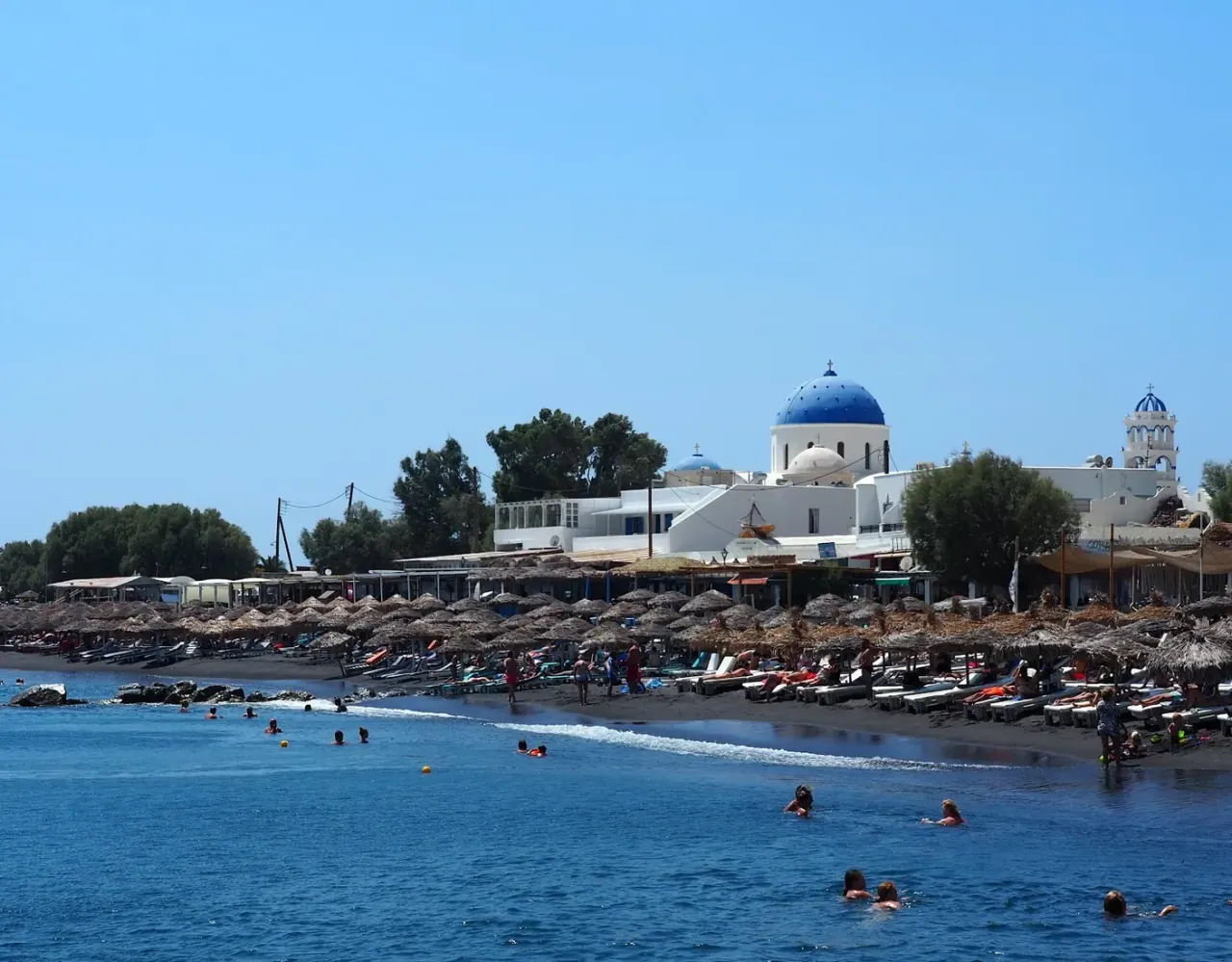
Most people arrive at Perissa having seen the photographs, a black crescent under a vertical grey rock, straw umbrellas in rows, water the colour of ink and glass, and get one thing badly wrong in the first ninety seconds. It is not the water, the price or the crowds. It is the sand, which on a July afternoon is hot enough to genuinely injure a bare foot, and which nobody warns you about at the bus stop. Get that one detail right and Perissa is the most rewarding beach day on Santorini. Here is how the bay actually works.
At a glance
| Detail | |
|---|---|
| What it is | Northern end of a continuous ~7 km black-sand sweep, Santorini's longest beach |
| Sand | Ground volcanic lava and basalt; dark grey to black, pebbly at some water entries |
| The hazard | Sand becomes scorching by mid-morning, sandals or water shoes are essential |
| Backdrop | The sheer rock of Mesa Vouno, with Ancient Thera on the ridge above |
| Sunbeds | Roughly €0–30 depending on the operator and the row |
| Free access | Yes, it is a public beach; you pay only for furniture and service |
| Wind | Mesa Vouno shelters the bay from the worst of the Meltemi |
| Getting there | KTEL buses from Fira; parking behind the beach road |
| Visitor rating | 4.4 from 4,348 reviews |
The sand: the one thing to get right
Black sand absorbs solar radiation instead of reflecting it. Pale shell-and-coral sand stays walkable in high summer; volcanic sand does not. By late morning between June and September the surface at Perissa reaches temperatures that make an unprotected barefoot crossing genuinely painful, and the twenty-metre walk from the beach road to the water's edge is exactly the stretch where people get caught.
The fix is trivial and almost universally ignored by first-timers:
- Bring sandals or water shoes, and keep them on until you are in the sea.
- Do not leave them at the towel if you plan to walk to a bar. You will need them for the return.
- Watch children constantly on the walk down; they are the ones who get hurt.
- A towel over the sand under your feet is a workable emergency measure if you have forgotten shoes.
Some water entries are pebbly rather than sandy, which is the other reason shoes earn their place in the bag. None of this is a reason to avoid Perissa, it is the reason the beach looks the way it does, but it is the difference between a good day and a limping one.
The water
Reports genuinely disagree about how Perissa shelves, and both are describing something real: the bottom varies along the length of the bay, and it can drop away faster in some places than the gentle entry elsewhere would lead you to expect. Treat the first few metres as unknown rather than assuming, particularly with weak swimmers, and use the lifeguarded sections in season.
What is consistent is the quality. The water runs exceptionally clear, the dark seabed makes it read as deep blue rather than turquoise, and the bulk of Mesa Vouno at the northern end shelters the bay from the Meltemi, the northerly summer wind that ruins beach days elsewhere on the island. On a day when the caldera side is being blown about, Perissa is frequently calm. That shelter is the beach's most underrated practical asset and the reason it stays swimmable more days per season than its reputation suggests.
What it costs, and where the free sand is
Perissa is a public beach. You can walk on, lay a towel and swim without paying anyone. What you pay for is the furniture, the shade and the service, and how much depends entirely on which operator's block you settle into, which is why quoted prices range from nothing to about €30.
The pattern along the bay is consistent: the plainer, cheaper sets sit toward the Perissa end, and prices climb as you walk south into Perivolos, where the designer loungers and DJ bars take over. Many beach bars also run a minimum-consumption model instead of a flat sunbed fee. You take the loungers "free" and commit to a drinks spend, which is better value than it sounds if you were going to order anyway. Our full breakdown of Perissa and Perivolos sunbed and beach-club prices covers which operators use which model and what Greece's beach-access law entitles you to.
Perissa or Kamari?
The two beaches sit on opposite sides of the same rock. Mesa Vouno separates them, and the road between takes far longer than the map suggests, so most people pick one and stay.
The short version: Perissa is the better-value, more relaxed side, with a longer run of sand and a younger, cheaper strip behind it; Kamari is tidier and more built-up, with a paved promenade and more hotel infrastructure. Both are black volcanic sand and both get equally hot. Our Perissa vs Kamari comparison works through it properly, and if you are still choosing a base, Perissa vs Fira vs Oia covers the wider decision.
Making a day of it
The beach is the reason to be here, but the bay has more in it than sand:
- Ancient Thera sits on the ridge directly above you, the Greco-Roman city on top of Mesa Vouno, reached by the hike up from Perissa. Go early; there is no shade on the path.
- The beach bars run from quiet tavernas at the northern end to full-volume clubs south toward Perivolos.
- Watersports cluster at the southern end of the strip.
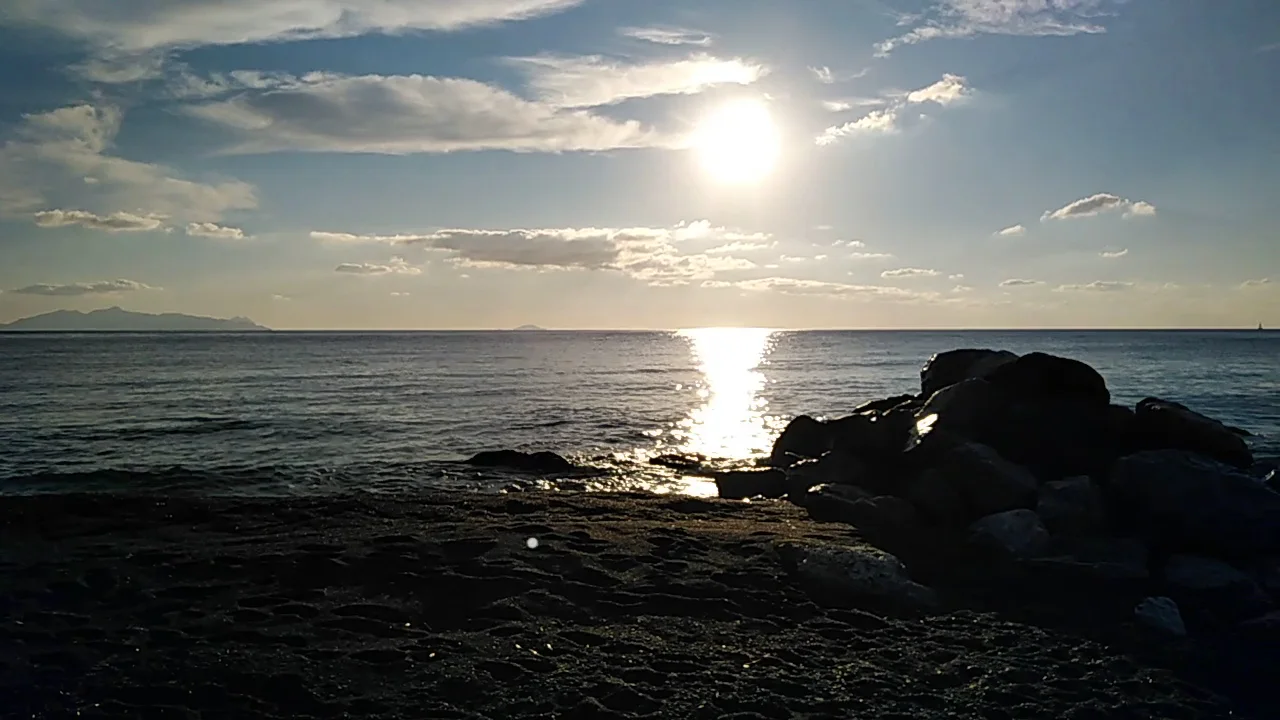
- Sunset is not Perissa's event, that belongs to the caldera side, but the light on the black sand in the last hour before dusk is the best photograph you will take here. For the classic view, see watching the Oia sunset from Perissa.
Go early morning for the calmest sea or late afternoon as the heat eases; the middle of the day in August is when the sand is at its worst and the strip at its busiest. For the month-by-month picture, see the best time to visit Perissa.
Frequently Asked Questions
Why is the sand at Perissa Beach black?
It is volcanic. The sand is ground-down lava and basalt thrown out by the eruptions that formed Santorini's caldera and buried Akrotiri, not the pale shell and coral sand of most Mediterranean beaches. The dark grains absorb heat rather than reflecting it, which is why the surface gets so hot.
Is Perissa Beach free?
Yes. Perissa is a public beach with free access. You can lay a towel and swim without paying. Charges apply only to sunbeds, umbrellas and beach-bar service, and many operators run a minimum-consumption deal instead of a flat sunbed fee. Prices are lowest at the Perissa end and rise toward Perivolos.
Do you need water shoes at Perissa Beach?
Effectively yes, in summer. The black volcanic sand reaches painful temperatures by mid-morning from June to September, and some water entries are pebbly rather than sandy. Sandals or water shoes for the walk between the road and the sea are the single most useful thing to pack for this beach.
Is Perissa Beach good for swimming?
Generally yes. The water is exceptionally clear and Mesa Vouno shelters the bay from the Meltemi wind, so it stays calm on days when the caldera side is rough. The seabed varies along the bay and can shelve more steeply in places, so check your entry point and use the lifeguarded sections.
How long is Perissa Beach?
Perissa is the northern end of a continuous stretch of black sand running roughly 7 km south through Perivolos and Agios Georgios, Santorini's longest beach. The Perissa section itself runs from the foot of Mesa Vouno along the village seafront before the character shifts at Perivolos.
For coordinates, the gallery and the landmark entry, see Perissa Beach; for the wider coast, see the best beaches near Perissa.